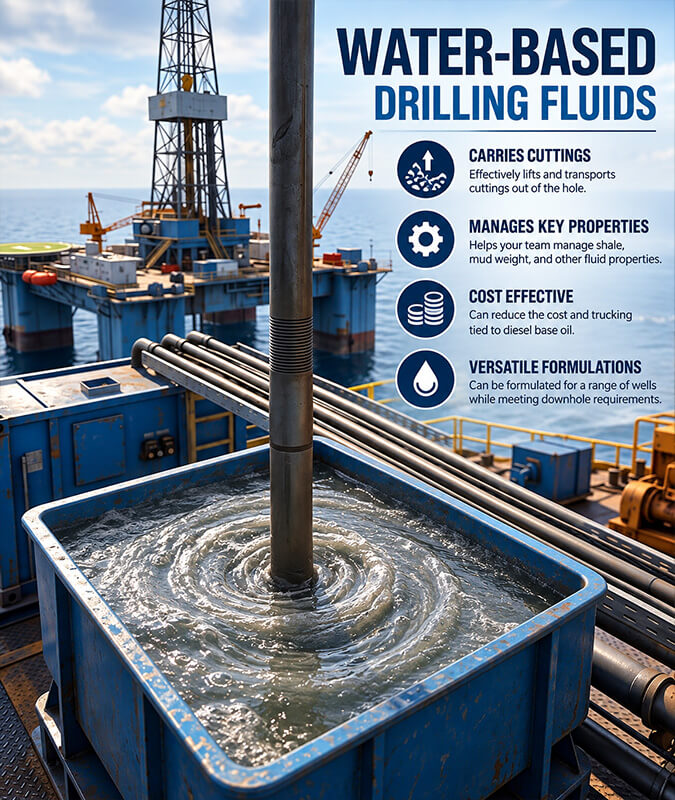

Water-Based Drilling Fluids
When reactive shale threatens hole stability, the mud system has to keep up with the well.
At Panther Fluids, we customize water-based drilling fluids for the well you need to drill. Our fluids experts help you select and manage the system from planning through drilling.
What Are Water-Based Drilling Fluids?
Water-based drilling fluids, or water-based muds, use water or brine as their main liquid phase. The mud carries cuttings out of the hole. Its formulation helps your team manage shale, mud weight, and other fluid properties.
Water-based mud can be formulated for a range of wells. It may also reduce the cost and trucking tied to diesel base oil. The system still has to meet the downhole requirements of your well.

When reactive shale threatens hole stability, you need a fluid program that limits hydration and swelling. Our WBM Inhibited systems can use gypsum, lime, saturated salts, polymers, and other additives to help keep shale in check.
We match the formulation to your formation and drilling conditions. The available polymers give us room to adjust the system as the well changes.

When your well calls for higher mud weights, solids and contamination can make fluid properties harder to control. Our WBM Dispersed systems use lignite and lignosulfonate additives for solids and contaminant tolerance.
These systems are typically used at higher mud weights. They can also be formulated for HP/HT conditions and high-ROP drilling.
Key Benefits
An inhibited WBM can help slow shale hydration, swelling, and breakdown. The right treatment depends on the shale you are drilling.
Dispersed WBM helps your team manage rheology when solids build and mud weight increases. Our field personnel monitor the system and recommend treatment as conditions change.
Both systems can be tailored to the well. Panther formulates inhibited WBM with ROP and shale inhibition in mind. Our dispersed systems are suited to high-ROP drilling where their fluid properties fit the program.
Water-based mud can help you avoid expensive diesel base oil and reduce trucking. We look at those costs alongside performance, treatment, and disposal across the full well.
Water-based systems may fit operations in environmentally sensitive areas. We evaluate the complete formulation and coordinate handling and disposal around your program’s requirements.
When Should You Consider Water-Based Mud?
Consider WBM when a water-based formulation can meet your well’s requirements and base-oil cost, logistics, or environmental conditions matter to the program.
WBM Inhibited may fit a well where shale control leads the fluid plan. WBM Dispersed may fit one that needs higher mud weights, solids tolerance, or an HP/HT formulation. A water-sensitive formation needs careful evaluation, and some wells will call for OBM or SBM.
At Panther, we assess the whole fluids program before recommending the right system for the job.
How Do SBM, OBM, and WBM Compare?
| FACTOR | SBM | OBM | WBM |
|
External phase |
Synthetic liquid | Diesel, mineral oil, or another petroleum-derived oil | Water or brine |
| Shale inhibition |
Typically high |
Typically high |
Varies by formulation and formation |
| Lubricity |
Typically high |
Typically high |
Varies by formulation |
| Temperature tolerance |
Can be formulated for high-temperature service |
Commonly used in high-temperature wells |
Specialized formulations may be required |
| Environmental considerations |
Qualifying synthetic base fluids can offer lower toxicity and improved biodegradability compared with conventional diesel-based mud |
Conventional diesel-based systems may involve greater toxicity, handling, and disposal considerations |
Often selected for a lower environmental footprint, depending on the complete formulation |
| Typical applications |
Reactive shale, extended-reach, high-temperature, offshore, and deepwater wells |
Reactive shale, high-temperature wells, and complex directional wells |
A broad range of drilling applications |
The initial cost of the mud is only one consideration. The full evaluation should also account for performance, logistics, waste handling, and total well cost.
At Panther, we help you select the system that best fits your drilling program.

How Does Panther Support Your WBM Program?
You need people at the wellsite who can keep mud properties on target as the well changes.
Panther provides complete drilling fluids treatment and management services. We configure, deliver, and manage complex fluid systems for all well types.
Our fluids management support includes:
- Customized fluid programs
- Drilling-fluid treatment and management
- Experienced wellsite personnel
- Fluid testing and monitoring
- Treatment recommendations
- Solids-control coordination
- Haul-off and disposal support
Panther’s on-site fluids experts can troubleshoot drilling problems and make recommendations. When drilling conditions change, our field personnel work with your team to adjust the mud system.
Why Work With Panther Fluids ?
At Panther Fluids, we combine drilling fluid systems with total fluid management to help simplify your wellsite operations.
Our services include:
- Fluids management
- Solids control
- Haul-off and disposal
- Equipment rentals
Panther can coordinate these services through a single point of contact and under one contract. This reduces the number of handoffs and gives you one team focused on your fluids program.
That is the Panther Advantage™. We handle the details of fluids management so you can stay focused on drilling the well.
Water-Based Drilling Fluids FAQs

Water-based mud uses water or brine with additives selected for the well. Panther’s inhibited systems can include salts, gypsum, lime, and polymers. Our dispersed systems use lignite and lignosulfonate additives.
WBM carries cuttings out of the hole and can be formulated to manage shale, mud weight, and fluid properties. Panther offers inhibited and dispersed systems for different formation and operating demands.
Depending on the formulation, WBM can support shale inhibition or solids and mud-weight control. It may also reduce diesel base-oil and trucking costs and fit a program’s environmental requirements.
Take On Your Next Well With Panther
Tell us about your well and the drilling challenges you expect to face.
Our Panther Fluids experts can help you determine whether WBM Inhibited or WBM Dispersed is the right fit for your drilling program.