
Oil headlines are loud, but E&P budgets, rig counts, and supply tell the story operators can plan around. This oil and gas outlook highlights the key signals we are tracking in 2026, including geopolitics, North America activity, LNG exports, and rising power demand from data centers and AI.
In This Outlook:
- Will oil prices stay range-bound?
- How will geopolitics affect supply flows?
- What are E&P budgets signaling for drilling and completion plans?
- Where do rig counts point for North America activity?
- How do LNG exports and Henry Hub shape the gas outlook?
- What impact will data centers and AI have on power demand?
- How does total fluid management help operators stay ahead?
Takeaway 1: Oil prices stay capped
Oil markets are being pulled in every direction. A single headline can move oil prices fast, but they keep circling the same question: has anything actually changed in the flow of barrels?
From where I sit, the question for 2026 is not whether volatility shows up. It is whether it changes fundamentals enough to alter how operators plan.
That matters heading into the new year because the market is not starting from scarcity. Oil markets began 2026 already saturated, with supply still greater than demand. That backdrop tends to cap sustained rallies, even when short-term volatility is intense.
Enverus describes 2026 as a reset year. Its outlook for the year points to softer conditions early as inventories build, with the potential for firmer pricing later in 2026 if the market tightens and stock draws take hold.
The result is a market that can feel chaotic without changing direction. Prices can react quickly to perceived risk, especially when it involves major producers or shifting trade flows. However, a lasting rally in oil prices needs proof. Until that proof shows up, most 2026 plans stay conservative.
Takeaway 2: Geopolitical uncertainty keeps the market choppy
The industry is in for a "choppy ride" this year, driven in large part by geopolitical uncertainty, as one economist told CNBC.
That volatility showed up almost immediately. Markets seesawed on reports that Venezuela’s president had been captured by U.S. forces just a few days into 2026. By mid January, prices jumped again as fears of unrest in Iran rose. In both cases, prices pulled back once it became clear there was no immediate change in supply flows.
For 2026 planning, Venezuela and Iran create two different kinds of volatility. With Venezuela, the story is mostly about the longer-term supply narrative and how quickly expectations can shift on policy and investment headlines. Meanwhile, Iran can move sentiment faster because escalation risk can rise quickly.
Put them together, and the takeaway we are hearing from operators is clear: 2026 plans stay conservative, with tighter programs and less appetite for getting ahead of the market.
Takeaway 3: E&Ps are budgeting for a tighter year
Most E&Ps are heading into 2026 with plans built to work in a lower, range-bound price environment. The goal is not to chase a rebound but to protect returns, stay focused, and avoid getting stretched if prices stay soft.
That caution is already showing up in the way activity is being described across the oil patch. In early January, the Kansas City Fed’s Energy Survey reported that fourth-quarter drilling and business activity fell to its lowest level since 2020, and respondents expected further contraction over the next six months.
Budgets reflect the same mindset. Many operators I am seeing are building programs that work at conservative price assumptions. In practice, that means tighter drilling and completion schedules and more attention on execution and well costs.
When capital stays disciplined, execution and cost control matter more than trying to time the next rally.
Natural gas is the brighter spot in the outlook. In both of the recent Dallas Fed and Kansas City Fed energy surveys, respondents were more optimistic about Henry Hub than WTI. Many also pointed to rising U.S. power demand and LNG as tailwinds for natural gas demand over time.
Takeaway 4: North America activity stays flat to down
The outlook for North America points to another year of muted activity. SLB, the world’s largest oilfield services provider, does not expect a significant pickup in North American drilling activity, CEO Olivier Le Peuch said, citing challenging economics in some shale plays.
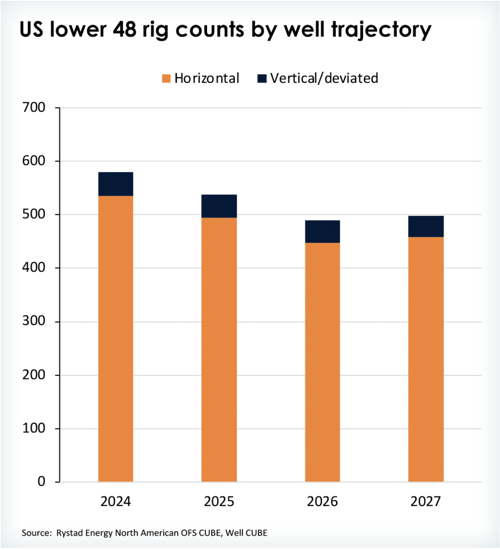
The latest Rystad forecast supports that outlook. The Lower 48 horizontal rig count is projected to keep trending lower into 2026.
Well completions are also projected to ease in several oil-weighted basins, including the Permian Basin, if oil prices hold in the low $60s.
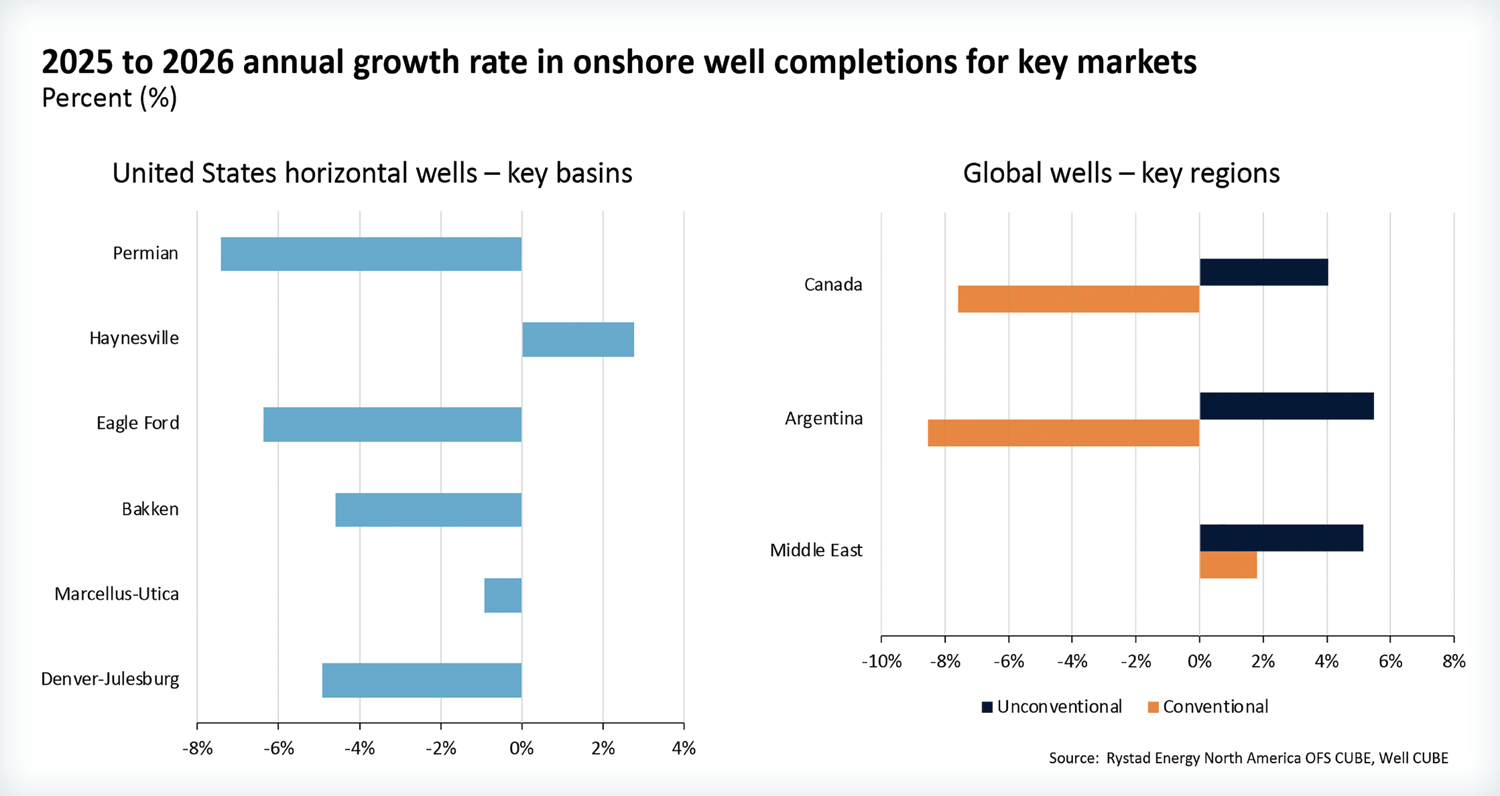
For Louisiana and East Texas, the Haynesville is a notable exception. Rystad expects well completions to increase modestly in 2026 if Henry Hub prices strengthen and LNG demand continues to build.
Takeaway 5: Gas, LNG, and rising power demand create the clearest opportunity
In a year where oil headlines can pull prices in opposite directions, the natural gas story is easier to follow. The demand drivers are clearer: LNG export growth along the Gulf Coast, and rising electricity load, with data centers supporting AI now part of the baseline outlook.
That combination is why market watchers expect a firmer Henry Hub environment than in 2025 as more LNG capacity comes online. Rystad points to gas-heavy basins with export access as the relative bright spot. For Louisiana and East Texas, that keeps the Haynesville on the short list, even if 2026 gains are expected to be modest.
Enverus frames the other side of the demand story. Power systems are under strain as electrification expands and AI-related load grows, which increases the importance of reliable generation and fuels. The EIA’s Short Term Energy Outlook reinforces the direction, projecting U.S. electricity demand will set new records in 2026 and 2027, with AI-driven data centers cited as a driver.
The constraint is timing. Demand can be real and still take time to show up as upstream activity if infrastructure lags. Grid upgrades, generation buildouts, and midstream takeaway capacity will shape how quickly the opportunity translates into work on the ground, and how aggressively operators choose to lean in.
How Operators Stay Ahead in 2026
If 2026 is a year defined by capped oil prices, choppy headlines, and tighter budgets, the edge comes from execution. The operators that win will be the ones that control costs, reduce nonproductive time, and keep the wellsite moving even when plans stay conservative.
That is where Panther Fluids fits in. Since 2017, our team has focused on one thing: total fluid management that keeps operations running smoothly under one simple contract. With more than 200 years of combined experience across major U.S. basins, Panther brings the on-site drilling fluids expertise, solids control, fully compliant haul off and disposal coordination, and wellsite rentals that help crews stay ahead of problems before they become delays.
The Panther AdvantageTM is straightforward: one contract, one team, one call. From drilling fluid systems to logistics coordination and the wellsite equipment, our goal is to help you run a cleaner, more efficient drilling program and protect the bottom line when every dollar is under a microscope.
Ready to Make Fluids Management Your Strategic Advantage?
At Panther, our fluids management experts engineer drilling fluid systems and manage the logistics to keep your drilling program tighter from spud to TD. Read our Guide to Total Fluid Management Service to learn how we help reduce well costs, maintain regulatory compliance, and simplify the administrative burden.